The challenge
Why are security teams moving away from Cribl?
Unpredictable per-GB pricing
Cribl charges per GB of data processed, so every new source, every log volume spike, and every expanded detection use case increases your bill. For security teams growing their telemetry coverage, costs become hard to forecast and harder to justify.
JavaScript maintenance burden
Cribl’s ~50 built-in functions cover the basics. Anything beyond that requires custom JavaScript your team writes, owns, and debugs indefinitely. When a vendor updates their log format, the fix lands in your queue.
No native security normalization
ASIM, OCSF, and CIM field mappings are manual in Cribl. Each new source requires its own parsing and mapping logic. Schema drift goes undetected until something breaks downstream.
Multi-product complexity
Stream, Edge, Lake, and Search are separate products with separate licensing and deployment. Getting full pipeline coverage means managing multiple components, not one platform.
The solution
What does the right Cribl alternative look like?
A good Cribl alternative for security teams does more than move data. It normalizes logs automatically to your SIEM’s schema, collects without agents where possible, and preserves every relevant event. It should be production-ready without scripting, maintained by the vendor rather than your team, and backed by commercial support and compliance certifications.
Most Cribl alternatives come from the observability space and carry the same general-purpose limitations. DataStream was built specifically for security data pipelines and meets all of these criteria out of the box.
How it works
VirtualMetric vs Cribl
The fundamental difference is the operating model. DataStream eliminates manual effort at every stage: collection, normalization, and reduction. All run automatically, without scripting or ongoing tuning.
| VirtualMetric DataStream | Cribl Stream | |
|---|---|---|
| Collection | Automated — agentless Zero-touch via WinRM / SSH with read-only credentials. No software on target systems. | Manual — agent-based Deploy, update, troubleshoot — ongoing agent management overhead. |
| Normalization | Automated — deterministic Automated field mapping to all schemas. Predictable output, no per-source tuning. | Manual — parsing + mapping rules Regex / grok + manual tuning per source. Requires ongoing pipeline maintenance. |
| Reduction | Automated — risk-free Volume reduced based on your detection rules, removing the fields and events they never use. No visibility gap. | Manual — sampling / event drops Entire events can be dropped. Blind spots possible. |
Features
How VirtualMetric DataStream compares to Cribl Stream
A detailed breakdown across the dimensions that matter most to security operations teams and architects.
|
VirtualMetric DataStream
|
Cribl Stream
|
|
|---|---|---|
| Security-first platform designed for SOC & SIEM | ||
| Collector & agent-based collection | ||
| Agentless collection (no software on target systems) | ||
| Automated security-aware filtering (no scripting required) | ||
| Automated field-level reduction (no events dropped) | ||
| Automated data transformation (no scripting required) | ||
| Automated multi-schema normalization (ASIM, ECS, OCSF, CIM, UDM) | ||
| Configurable pipeline processing | ||
| Real-time processing | ||
| Intelligent data routing | ||
| Compliance & tiered storage routing | ||
| Zero data loss guarantee | ||
| Native threat intelligence enrichment | ||
| Contextual enrichment (user, asset, environment metadata) | ||
| Detection-ready log output | ||
| Customer-controlled data residency | ||
| Full air-gap / offline deployment support | ||
| Flexible deployment (on-prem, cloud, hybrid) | ||
| SaaS control plane | ||
| Distributed / scalable pipeline architecture | ||
| Active-active high availability | ||
| Role-based access control (RBAC) | Granular | Basic |
| Multi-factor authentication (MFA) | ||
| Single sign-on (SSO) | ||
| Native multi-tenant architecture (MSSP support) | ||
| Field-level masking & redaction | Deterministic, fully auditable | AI-based scanning, non-auditable |
| Pipeline processing metrics | ||
| Telemetry volume analytics | ||
| Destination-level metrics | ||
| Content / vendor pack management | Pre-validated security packs | Community/configuration templates |
| Platform health monitoring with alerting |
Why security teams choose DataStream
Your data never leaves your environment
DataStream enforces a strict separation between data plane and control plane. The Director processes all log data locally within your infrastructure — VirtualMetric Cloud handles only management metadata. Zero customer logs processed or stored externally. Single outbound HTTPS on port 443, no inbound connections, full air-gap support.
220+ no-code processors vs ~50 Cribl functions
DataStream ships with 220+ processors in a no-code syntax security engineers already know. Cribl offers ~50 built-in Functions — anything beyond that requires custom JavaScript. It leads to more developer dependency and ongoing maintenance overhead.
10x speed, no Kafka — and 40x less memory
A vectorized engine delivers 10x faster processing with up to 99% VMF compression and a built-in WAL for 100% delivery guarantee. For a 2 TB/day workload: 2 cores and 256 MB RAM versus Cribl’s 5 cores and 10 GB — no Kafka or external message broker required.
Deterministic optimization, fully auditable
DataStream’s Risk-Free Reduction cuts data volume by up to 90% and higher. It runs on explicit rules: the fields and events you name, or the fields and events your own detection rules never read. Every drop traces back to the rule that made it. No AI, no model training on customer data.
Production-ready in under 30 minutes
DataStream collects data over WinRM and SSH using read-only credentials — nothing installed on target systems, nothing to maintain. Pre-built vendor packs deploy out of the box, so data reaches your target in the correct schema immediately. No scripting, no dedicated pipeline engineer.
Multi-target routing from one pipeline
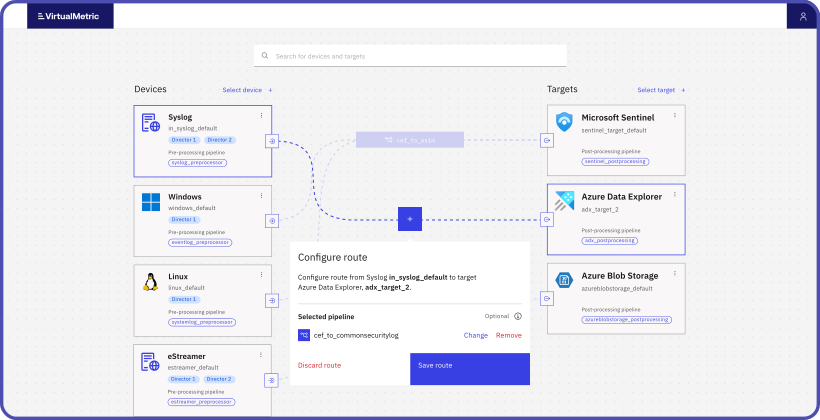
Route simultaneously to multiple targets, each in its native schema, from one pipeline — run parallel SIEM evaluations, migrate without downtime, or feed a data lake and SIEM at the same time, without touching a single data source.
Automatic multi-schema normalization
Native bi-directional conversion between ASIM (Sentinel), OCSF (Amazon Security Lake), ECS (Elastic), CIM (Splunk), and UDM (Google SecOps) — automatic field mapping per destination with no manual configuration. Detection content fires correctly on arrival.
Purpose-built for MSSPs
The Director Proxy enables full multi-tenant deployments: each customer installs a lightweight proxy in their own environment and shares only an endpoint and token. The MSSP operates centrally with no access to customer credentials or infrastructure. Complete tenant isolation by design.

Easy migration
Import your existing Cribl pipelines
Import a Cribl Stream pipeline export from the DataStream pipeline wizard. An AI agent connected to the DataStream MCP server can run the same import. Each Cribl function becomes a native processor, in the original order. Disabled steps carry over as disabled. Functions without a native equivalent stay in the pipeline as comments with their full original configuration, ready for review.
Frequently asked questions
How is VirtualMetric different from other Cribl competitors?
Most Cribl alternatives were built for observability: managing metrics, traces, and application logs for DevOps and IT teams. VirtualMetric DataStream is built for security. Everything is optimized for SIEM ingestion, detection content, and compliance requirements. Other tools bring something to the table, but none are purpose-built around security-native normalization and MSSP-grade multi-tenancy the way DataStream is.
What should I look for in a Cribl alternative?
Start with normalization: does the tool automatically map data to your SIEM’s native schema without manual overhead? Then check the data loss model: sampling drops events and creates detection gaps, so look for field-level reduction instead. Finally, check the maintenance model: how much scripting is required? Who updates integrations when log formats change? And what support and compliance certifications back the platform?
Is there a free or open-source Cribl alternative?
Logstash is the most widely used open-source option – free, flexible, and backed by a large plugin ecosystem. The trade-off is that every Grok pattern, every field mapping, and every vendor update becomes your team’s responsibility to maintain. There are no pre-built security packs, no automatic SIEM normalization, and no commercial support behind it. VirtualMetric DataStream also offers a free tier covering up to 500 GB of daily ingestion. It includes all the main platform capabilities without requiring manual scripting.
Read how Logstash compares to DataStream here.
We’re already using Cribl. Is switching realistic?
Yes. Import a Cribl Stream pipeline export from the DataStream pipeline wizard, or have an AI agent connected to the DataStream MCP server run the same import. Each Cribl function becomes a native processor, in the same order. Anything without a native equivalent stays in the pipeline as a comment with its original configuration, so nothing is lost. DataStream can also import existing DCR rules where applicable, and a first pipeline can run within 30 minutes.
We don’t have a dedicated pipeline engineer. Can we still use DataStream?
That’s exactly who DataStream is built for. Pre-built vendor packs and automatic normalization handle the heavy lifting. You don’t need JavaScript, regex tuning, or ongoing pipeline maintenance. Teams deploy and start sending clean data to their SIEM without any dedicated pipeline resource.
How does DataStream handle sources that Cribl already supports natively?
DataStream supports 300+ sources via agentless collection over WinRM and SSH, as well as agent, collector, TCP/UDP, HTTP/REST, and file monitoring. If Cribl already receives data from a source, DataStream can collect from the same source — no dependency on Cribl. For sources not yet covered, VirtualMetric can deliver a new vendor pack within a day on request.
We’re evaluating multiple SIEMs in parallel. Can DataStream help with that?
Yes, you can route the same data to multiple SIEM destinations simultaneously, each in its native schema, from a single pipeline. That means you can run a live parallel evaluation without touching your data sources or duplicating your collection infrastructure.
We have a heavily customized Cribl setup. Would we lose that flexibility?
In practice, you’d gain it. DataStream’s 220+ built-in processors cover the vast majority of what custom JavaScript handles in Cribl — field removal, event filtering, enrichment, schema transformation — but with a fraction of the CPU and memory overhead. Custom logic based on your specific alert queries is fully supported. Teams that have spent months tuning Cribl pipelines typically find they can replicate and improve on that setup in DataStream with significantly less effort.
Is DataStream suitable for regulated environments?
Yes. Data sovereignty is built into the architecture. Logs never leave your environment, and the control plane handles only management metadata. Field-level masking, redaction, and retention controls are available out of the box. Because optimization is deterministic and fully auditable, compliance teams can trace every decision. DataStream is used in environments subject to GDPR, NIS2, HIPAA, SOX, and supports full air-gap deployments.
Talk to our experts
Schedule a technical session with our engineering team to see how DataStream compares to what you’re running today.
Try DataStream
Route data to your SIEM in the correct schema, with automatic normalization and up to 90% data volume reduction.
Try now