The challenge
Why are security teams moving away from Logstash?
Silent detection gaps
When a vendor updates their log format, your Grok pattern breaks silently. Events stop mapping correctly, fields go missing, and detection rules fire on incomplete data. No alert. No dashboard. Just a gap that grows until someone notices during an investigation.
No compliance audit trail
Logstash has no native record of pipeline changes. There is no log of who modified a filter, when it was changed, or what data was affected. For teams under GDPR, NIS2, HIPAA, or SOX, this is not a missing feature — it is a compliance exposure.
Manual schema mapping for every SIEM
Logstash normalizes to ECS for Elastic destinations. Sending data to Sentinel, Splunk, or Google SecOps requires custom field mapping logic per source, per destination. Every new source multiplies the maintenance surface.
Two systems to maintain
Logstash has no collection layer. Filebeat, Winlogbeat, or another Beat must be deployed and maintained on every source system separately. So you are running two pipelines on every host in your environment.
The solution
What does the right Logstash alternative look like?
A good Logstash alternative for security teams does more than replace a pipeline tool. It collects without a separate agent fleet, normalizes automatically to your SIEM’s schema, and preserves every security-relevant event. It should be production-ready within hours (not weeks), maintained by the vendor, and backed by commercial support and compliance certifications.
Most Logstash alternatives were built for observability or general data engineering. They solve the mechanics without addressing the security-specific gaps. DataStream was built specifically for security operations and meets all of these criteria out of the box.
Features
Logstash is a pipeline engine. DataStream is a full pipeline platform.
Logstash is part of a broader stack — Beats for collection, Elasticsearch for storage, Kibana for visibility. Each component has its own deployment and update cycle. DataStream replaces that complexity with a single, commercially supported platform: ISO 27001 certified, SOC 2 Type II compliant, with automatic security patches and no separate agent fleet to maintain.
|
VirtualMetric DataStream
|
Logstash
|
|
|---|---|---|
| Primary role | End-to-end security data pipeline platform | Data processing engine (ETL component) |
| Data collection | Built-in — agentless + agent-based | Limited (input plugins); typically relies on Beats |
| Pipeline configuration | No-code / declarative | Code-based (Ruby DSL, Grok) |
| Pre-built integrations | Vendor packs — security-focused | Community plugins |
| Data transformation | Built-in processors (220+) | Filters via plugins (manual config) |
| Schema normalization | Automatic — ASIM, ECS, OCSF, CIM, UDM | Limited (ECS mainly; others manual) |
| Enrichment | Native — TI, context, metadata | Plugin-based (manual setup) |
| Routing | Intelligent, multi-destination | Conditional outputs |
| Real-time processing | ||
| Performance efficiency | High — optimized, compressed pipeline | Resource-intensive (heap tuning required) |
| Data reliability | WAL-based — no data loss | Persistent queue (at-least-once) |
| Setup time (new source) | Minutes — pre-built packs | Hours–days (parsing + testing) |
| Maintenance overhead | Vendor-maintained | User-maintained configs |
| Pipeline visibility | Built-in — end-to-end | Via APIs / Kibana (external) |
Why security teams choose DataStream
Agentless or agent-based – your choice
DataStream supports both agentless pull collection and push-based ingestion (Syslog, TCP/UDP, HTTP) – with nothing installed on target systems. Where deeper endpoint visibility is needed, lightweight agents are available. Logstash provides input plugins for ingestion, but in practice relies on external shippers like Beats. Before a single log arrives, you’re already managing a separate fleet on every source system.
220+ no-code processors – no Ruby required
DataStream ships with 220+ processors in a declarative, no-code syntax. Filtering, enrichment, normalization, masking, and routing are all configured without scripting. Logstash pipelines are built in Ruby DSL with Grok patterns – every rule is custom code your team owns, debugs, and maintains indefinitely. Every new source, every schema change, and every edge case adds to that burden.
10x speed – and a fraction of the memory
A vectorized engine delivers 10x faster processing with up to 99% VMF compression and a built-in WAL for 100% delivery guarantee. For a 2 TB/day workload: 2 cores and 256 MB RAM. Logstash runs on the JVM, typically requiring JVM tuning and significantly more memory compared to lightweight pipeline engines, and is often scaled horizontally to handle high-volume workloads.
Automatic multi-schema normalization
DataStream automatically maps data to ASIM (Sentinel), OCSF (Amazon Security Lake), ECS (Elastic), CIM (Splunk), and UDM (Google SecOps) – per destination, with no manual configuration. Logstash supports ECS natively, but only for Elastic destinations. Normalizing for Sentinel or any other SIEM requires building and maintaining custom field mapping logic from scratch.
Production-ready in under 30 minutes
Pre-built vendor packs deploy out of the box, so data reaches your target in the correct schema immediately, without scripting or a dedicated pipeline engineer. A typical Logstash deployment for a new source takes from hours to days, depending on log format complexity: writing Grok patterns, testing against sample logs, handling edge cases, and deploying Beat configuration across the estate.
Security-specific vendor packs – maintained for you
DataStream’s Content Hub ships pre-built packs for Fortinet, Palo Alto, Check Point, Cisco, and more – all validated against real detection content. Logstash has no equivalent. Community plugins exist, but there is no SLA, no validation against detection content, and no guarantee they are updated when a vendor ships a firmware update. Your team owns every fix.
Full visibility into your pipeline
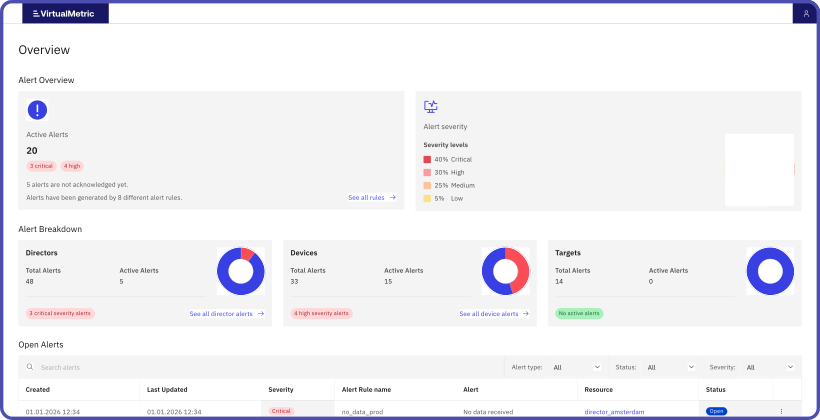
DataStream provides end-to-end pipeline visibility: source health, volume analytics, schema drift alerting, and anomaly detection. If something breaks upstream, you know before your detection coverage is affected. Logstash has no built-in, unified observability layer. Visibility typically requires Elastic Stack components. If a Grok pattern silently breaks, someone finds out during an incident.
Full audit trail – every change, every access
Every pipeline configuration change, every access event, and every modification in DataStream is logged, attributable, and available for compliance review. Logstash has no native audit trail for pipeline changes without external tooling. For teams operating under GDPR, NIS2, HIPAA, or SOX, this is a meaningful compliance gap.

Easy migration
Import your Logstash configs
Import a Logstash .conf file from the DataStream pipeline wizard. An AI agent connected to the DataStream MCP server can run the same import. Filter plugins become native processors, and conditionals become native conditions. Inputs and outputs are kept as notes, since DataStream sets up sources and destinations separately. Anything without a direct equivalent is flagged with a warning for review.
Frequently asked questions
What should I look for in a Logstash alternative for security operations?
Start with the collection model: does it require agents on every source, or can it collect agentlessly? Then check schema support: does it normalize automatically to your SIEM’s native schema, or does each destination require manual field mapping? Finally, check the compliance model: is there a built-in audit trail for pipeline changes, and is the platform commercially supported with automatic security patches? A tool that requires you to maintain the same operational surface as Logstash is not really an alternative.
Can DataStream replace both Logstash and Filebeat in one deployment?
Yes. DataStream collects directly over WinRM and SSH using read-only credentials, removing the need for Filebeat, Winlogbeat, or any other Beat on source systems. For network devices, appliances, and cloud sources, push-based ingestion via Syslog, TCP/UDP, and HTTP is supported out of the box. One platform replaces both the collection layer and the pipeline layer with nothing installed on target systems.
Can DataStream replace Logstash without disrupting existing pipelines?
Yes. DataStream can run in parallel with your existing Logstash setup, collecting from the same sources simultaneously. This lets you validate DataStream’s output against what Logstash currently produces before cutting over, with no risk to production visibility. Most teams complete the transition source by source within a few days.
We’ve invested months in our Logstash config. What carries over?
The routing logic and destination endpoints carry over directly. The parsing and normalization logic does not – DataStream replaces Grok patterns and Ruby filters with pre-built vendor packs and its 220+ processor library. For most teams, this is the point: the config you’ve built is what DataStream is designed to make unnecessary going forward. Source-specific tuning that took weeks in Logstash typically takes minutes in DataStream.
Can we reuse our existing Logstash pipelines?
Yes. Import a Logstash .conf file from the DataStream pipeline wizard, or have an AI agent connected to the DataStream MCP server run the same import. DataStream converts the filter section into native processors, including grok, dissect, mutate and conditionals. Plugins without an equivalent, such as metrics, stay as comments with a warning. You then connect sources and destinations as DataStream devices and targets.
Our team knows Ruby and Grok. Is DataStream flexible enough for custom logic?
Yes. DataStream’s 220+ processors cover the vast majority of what custom Logstash filters handle: field removal, event filtering, enrichment, masking, schema transformation, and conditional routing – without scripting. For logic that goes beyond the built-in processors, custom pipeline conditions based on your specific alert queries are fully supported. Teams that have spent months tuning Logstash typically find the equivalent logic is simpler to express in DataStream and no longer breaks when upstream sources change.
Does DataStream work with other SIEMs besides Microsoft Sentinel?
Yes. DataStream is vendor-agnostic and can route to Splunk, Elastic, Google SecOps, Amazon Security Lake, CrowdStrike, and any destination that accepts standard formats. Sentinel is a common starting point because DataStream’s ASIM normalization is particularly deep there, but the platform works equally well across any combination of destinations simultaneously.
Who maintains the vendor packs when a source changes its log format?
VirtualMetric does. When a vendor updates their log format (a firewall firmware update that reshuffles field names, a cloud service that changes its event schema), the corresponding vendor pack is updated. Your pipeline continues working without any action from your team. With Logstash, a vendor update that breaks a Grok pattern lands in your queue: your engineers diagnose the failure, update the config, test it, and redeploy. That cycle repeats for every vendor, every update.
How is VirtualMetric different from other Logstash alternatives?
Most Logstash alternatives were built for observability or general-purpose data pipelines. They replace the mechanics of Logstash without addressing the security-specific gaps. DataStream was built exclusively for security data pipelines. Vendor packs are validated against real detection content, normalization targets ASIM, OCSF, CIM, and ECS automatically, and the platform includes a compliance audit trail, schema drift detection, and MSSP-grade multi-tenancy. It replaces Logstash and Filebeat in one deployment, purpose-built for SOC operations.
Talk to our experts
Schedule a technical session with our engineering team to see how DataStream compares to what you’re running today.
Try DataStream
Route data to your SIEM in the correct schema, with automatic normalization and up to 90% data volume reduction.
Try now