The shift to autonomous and AI-assisted security operations is well underway. But there is a quiet infrastructure decision that will determine whether your AI agents are sharp or sluggish: how your security data is structured before it ever reaches them.
The problem with raw log data
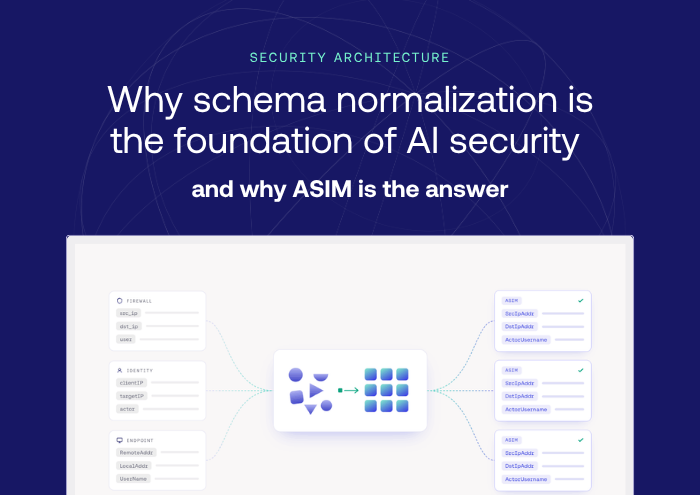
Modern SOCs ingest data from dozens of sources: firewalls, identity providers, endpoints, cloud workloads, SaaS applications. Each vendor formats its logs differently. Field names vary. Timestamps differ. IP addresses appear in different columns. What looks like the same event from two sources may be almost unrecognizable as such to an automated system.
For years, teams worked around this with manual parsing, custom queries, and institutional knowledge. Analysts learned to navigate the inconsistencies. Detection engineers built source-specific logic. It was inefficient, but it worked, at human speed.
AI agents operate at a different speed. And they are far less tolerant of ambiguity.
What ASIM brings to the table
The Advanced Security Information Model (ASIM) is Microsoft’s schema normalization framework for Microsoft Sentinel, designed to map security events from any source to a consistent, predictable set of fields and tables. Instead of every source having its own naming conventions, ASIM defines common fields — SrcIpAddr, DstIpAddr, ActorUsername, EventType — that mean the same thing regardless of where the data originated.
The immediate operational benefits are well understood:
- Unified detection rules that work across sources without modification
- Simpler query writing for analysts who no longer need to learn per-vendor field mappings
- Easier cross-source correlation, since entities are consistently named and typed
But the implications for AI-assisted and autonomous SOC operations go considerably further.
ASIM as AI infrastructure
When you deploy AI agents in a SOC — whether for alert triage, threat hunting, investigation summarization, or autonomous response — those agents consume security events as context. The quality, structure, and volume of that context directly determine the quality of their reasoning.
1. Consistent semantics reduce reasoning errors
An AI agent reasoning about a potential lateral movement attack needs to correlate authentication events with network flows and process execution logs. If those events come from three different sources with three different field naming conventions, the agent must either be explicitly taught to handle each one, or it will make mistakes.
With ASIM normalization, the agent receives a consistent semantic layer. SrcIpAddr is always the source IP. ActorUsername is always the actor. The agent can apply the same reasoning logic regardless of the originating vendor. This is not just convenient. It materially reduces the risk of false negatives from schema confusion.
2. Normalized data reduces token consumption
This is the more underappreciated dimension. Large language model-based agents process context in tokens. Every field in an event that gets passed to an agent consumes tokens. Raw, vendor-native log formats are often verbose, carrying dozens of fields that are irrelevant to the detection or investigation at hand.
ASIM normalization strips events down to a defined, purposeful field set. Fewer fields per event means smaller context windows per query. In a SOC environment where an agent may process hundreds of events during a single investigation workflow, that reduction compounds significantly — both in cost and in response latency.
Put simply: a leaner schema means faster, cheaper AI agents.
3. Schema consistency enables reusable agent logic
One of the core promises of AI in security is that detection and investigation logic can be written once and applied broadly. That promise only holds if the underlying data is consistent. An AI agent trained or prompted to investigate brute force attacks should work the same way whether the authentication events come from Azure AD, Okta, or on-premises Active Directory.
ASIM makes that possible. Without schema normalization, every new data source becomes a customization project for analysts and AI agents.
The migration argument
For organizations running on Common Security Log (CSL) or other raw ingestion approaches, the natural question is: why switch?
The answer is increasingly clear. CSL was designed for a world where humans parsed logs. ASIM is designed for a world where machines do. The transition may require upfront investment in parsers and pipeline configuration, but the return — in analyst efficiency, detection coverage, and AI agent performance — compounds over time.
Security data pipelines that normalize to ASIM at ingestion, before data reaches the SIEM, are particularly well-positioned here. Normalization at the pipeline layer means clean, structured data flows into every downstream system, whether that is a SIEM, a data lake, or an AI reasoning engine, without requiring schema handling logic at each consumption point.
Looking ahead
The SOC of the next few years will be defined not just by which AI tools you deploy, but by how well your data infrastructure supports them. Schema normalization is not glamorous work. It does not generate headlines. But it is the difference between AI agents that reason clearly and agents that hallucinate, miss correlations, or consume excessive compute on noisy, redundant fields.
Organizations that treat ASIM normalization as a strategic data infrastructure investment rather than a Sentinel-specific configuration detail will be better positioned to operationalize the wave of AI-native security tooling now coming to market.
The foundation matters. Now is the time to build it right.
VirtualMetric DataStream normalizes security telemetry to ASIM, OCSF, ECS, and other schemas at the pipeline layer, before data reaches your SIEM or AI tooling. Learn more.
See VirtualMetric DataStream in action

Start your free trial to experience safer, smarter data routing with full visibility and control.
Related content
Security Architecture
You Can't Detect What You Never Collect: Telemetry Coverage in the Agentic SOC
Security Architecture
The AI Zero-Day Wave Is Here. Is Your Logging Infrastructure Ready?
Security Architecture
VirtualMetric’s Hybrid Security Data Collection Architecture: Performance and Scale Without Compromise
Security Architecture